
🎄 Treat yourself to a nice gift. You deserve it! 🎄
34,95€
Sensorial education is fundamental in Montessori pedagogy, since it is based on the natural interest of children at these ages in exploring and perceiving all the details surrounding them.
In this course you are going to learn about the materials that guide children in their process of organising information and promoting their cognitive development.
After successfully completing the activities requested at the end of each module, the student will receive a Certificate in digital format, awarded by the International Montessori Institute as the official training center for Montessori pedagogy.
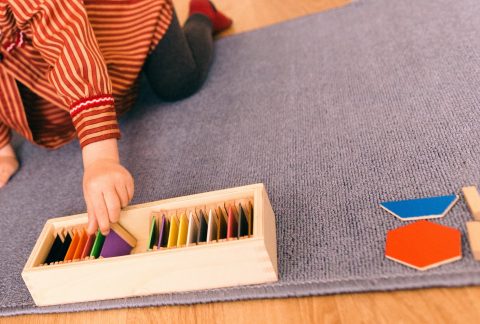
Sensorial education is one of the axes of the Montessori method, which takes advantage of children’s interest in exploration and the ease of perceiving details, between three and six years of age.
“The education of the senses should be begun methodically in infancy and should continue during the entire period of instruction which is to prepare the individual for life in society.”
Maria Montessori
Beyond stimulating the different sensorial channels, the materials designed by Dr Montessori offer the possibility of organising information and favouring cognitive development through classification and serialisation.
The characteristics of these materials that stand out are the self-correction and the introduction of the child to abstract concepts through concrete experiences.
The work in this area prepares children for further learning related to Mathematics and Geometry and develops some necessary skills for reading and writing, in the words of Dr Montessori:
“Sensorial development precedes that of a higher intellectual activity”.
100% online training
Without schedules, sign up and start now!
IMI Certificate, accrediting 20 hours of training
Up to 60 days to complete the course
Learn some theoretical foundations related to sensorial education in Montessori pedagogy.
Identify general purposes and characteristics of this area.
Reflect on the importance of the sensorial area in this stage of life.
Identify the groups of sensorial materials exercises.
Learn the indirect preparation to other work areas that is achieved through the sensorial materials.
Identify the main aspects for the implementation of this pedagogy.
Teaching team with great knowledge and international experience in Montessori classrooms.
Didactic material: in our virtual campus you will find theoretical and practical content and videos.
Sensorial education is one of the axes of the Montessori method, which takes advantage of children’s interest in exploration and the ease of perceiving details, between three and six years of age.
“The education of the senses should be begun methodically in infancy and should continue during the entire period of instruction which is to prepare the individual for life in society.”
Maria Montessori
Beyond stimulating the different sensorial channels, the materials designed by Dr Montessori offer the possibility of organising information and favouring cognitive development through classification and serialisation.
The characteristics of these materials that stand out are the self-correction and the introduction of the child to abstract concepts through concrete experiences.
The work in this area prepares children for further learning related to Mathematics and Geometry and develops some necessary skills for reading and writing, in the words of Dr Montessori:
“Sensorial development precedes that of a higher intellectual activity”.
Contemporary experts in human development highlight the relationship between sensorial and cognitive development during the first years of life and validate Montessori’s approach on the importance of educating the senses.
This course is aimed at both families and education specialists, since it can be used in different areas, such as: in the family home, after-school centres, schools and nurseries, etc.
Examples of representative materials for each group.
Completa el formulario y recibe por email todos los detalles de esta formación.